
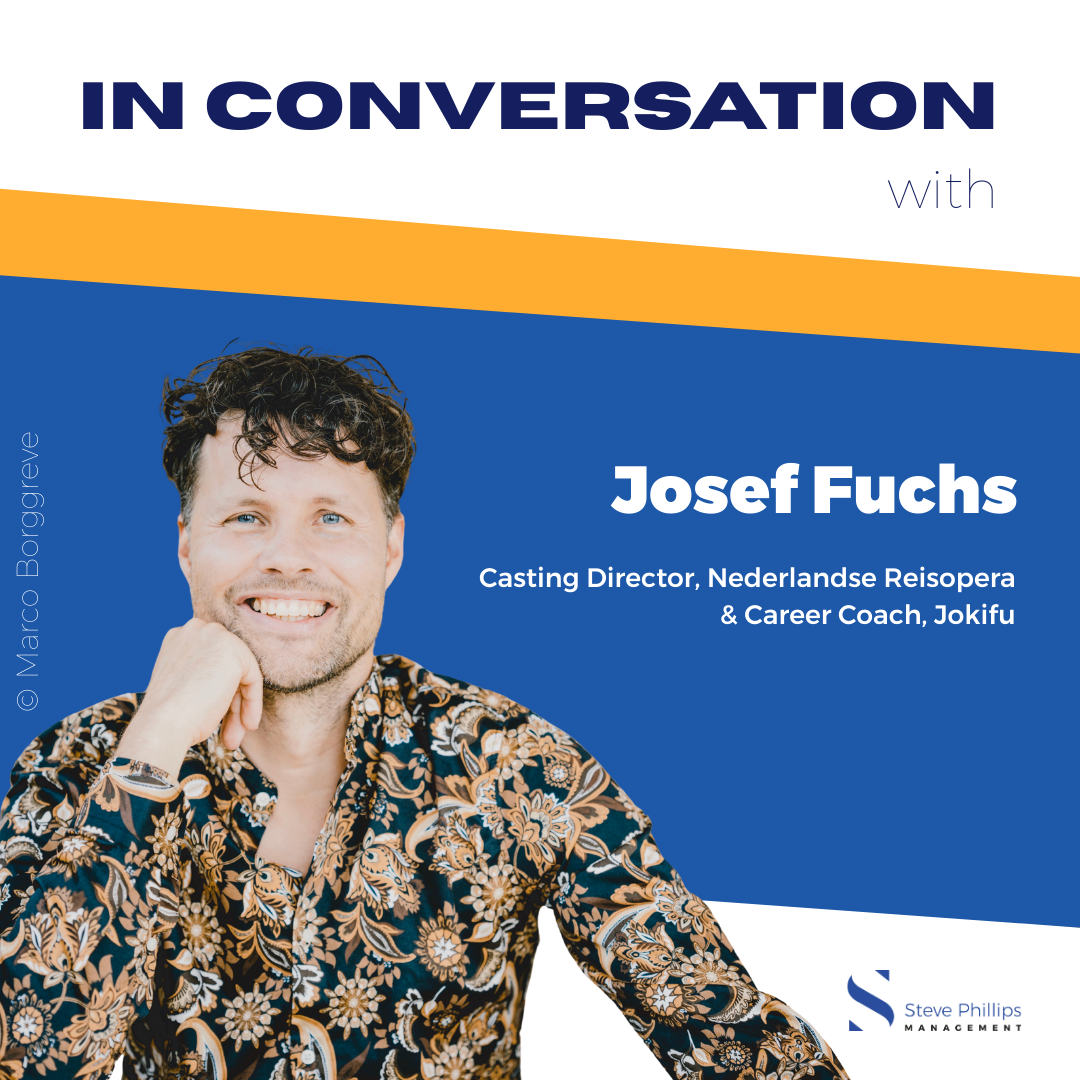
In conversation with Josef Fuchs
Josef Fuchs is Casting Director at the Nederlandse Reisopera and recently launched his own career consultancy: Jokifu Coaching | Empower Artists Today
Starting his career in Salzburg and Vienna, Josef has been on the jury for several international vocal competitions, including the Ada Sari Competition, the Belvedere Singing Competition, and the International Vocal Competition ’s-Hertogenbosch.
How have early career influences, your own performing experience and casting in the Netherlands shaped your passion for career coaching?
I’m a very curious person and am drawn to a Tapas-type lifestyle, feeding myself lots of information and sources of inspiration. Through my early career in Salzburg, I wanted to be on stage, yes, but also wanted to understand what a Festival was and what elements were connected to that. I wanted to see the organisation from all sides and truly understand the structure of how things work.
That curiosity was a burden in early life, when I felt I needed to focus on one thing, but I’ve since learned to embrace it. While singing at the Wiener Burgtheater and Theater an der Wien I therefore continued to enjoy a diversity of jobs, collaborating with Austrian summer festivals in casting, consulting, and production management. I then joined Vienna-based agency Sono Artists where I could further explore and grow my motivation, knowledge and how to collaborate with people. One thing led to another, with more puzzle pieces falling into place as I moved from performer to cultural manager to agent.
At 34, I felt I’d reached the top of what I could achieve in Austria career-wise, and the scene in Vienna wasn’t what I needed at that time. For my personal growth it felt important to leave the comfort zone of my home country. In 2014 I was appointed Head of Casting and Artistic Affairs at the Nederlandse Reisopera and relocated as I knew I wanted to develop, to redefine myself. I knew it would be difficult but also felt I needed to do it. Personal growth is a vital element in the singers’ journey, and why I love to coach. Through my own experiences I know what motivates performers and what challenges they face. I think of coaching as a team effort, a collaborative process, and learn something new from everyone I work with. I don’t believe it‘s my last puzzle piece either, it just aligns perfectly to the neighbouring pieces right now.
Many singers need to relocate countries for their careers, what would you advise from your own experience doing this?
Find a network, find some kind of starting community – social activities you enjoy will help you start learning the language. I’m interested in these alternative ways of discovering things. Be curious, be open and be ready to accept what might feel like a downgrade when first moving to a new country. You might want the same things as your peers straight away but remember they may have invested more years into the same system and are further ahead. Trust you‘re in the right spot and know that everyone has a certain space to hold. It’s just a matter of time while you allow things to unfold.
To start with you may not know the language, or anyone who lives there, and very often you may be working more than full time hours. I found all that challenging, but I also wanted to challenge myself and chose to immerse myself in the language early on. I was quite quiet to start with, as had complex sentences in mind I couldn’t express, and had anxiety about saying something stupid. After a year though, I‘d achieved real progress having started a language course in the first four months of arriving. Colleagues would respectfully acknowledge I was getting used to the language and accommodate accordingly. There was an internal policy to have internal meetings in Dutch, and I was encouraged to write key words down to share. Also, the meetings tended to use a common language around opera, planning and scheduling which helped with familiarity. Certainly, the ability to speak both German and English helped with the hybrid nature of Dutch (which has links to old German).
In terms of the culture, it can be easy to make assumptions before you arrive. We are all full of prejudices and tend to put things in boxes, that’s how our brains work. The Netherlands is very liberal in terms of values and lifestyles, but there can be right winged politics wherever you go. That’s just the reality. Don’t be disillusioned by this, just land and look around you – absorb. I liked the reality check! In any country, find the people you click with. What resonates in terms of things, values and people? Be receptive, again be curious. Don’t shy away from connecting with the language and culture. It will empower you so much, particularly if you stay longer and want to buy a house, understand contracts etc. There are AI tools, but absorbing everything as fully as possible will pay dividends in the long run.
In my experience the job swallowed me whole in the first few years and I would encourage singers to give enough care to their social life. Block time devoted to socialising, with ex pats but also native speakers and foreign artists. Make space for things you love with like-minded people and that will help you settle more: in my experience that was a community garden. The job itself is only a job, it cannot be everything.
What are the common myths around auditions, casting and agents?
Auditions are connected to the coaching I do, as it‘s a key part of the process in finding work for a singer. For me, I don’t want to see perfectness in that sense. As a panellist I want to relax into the audition performance. That’s what it needs to feel like, a real performance in the moment. The singer needs to make the panel feel like we‘re in their space and within their portrayal of the character. It’s really wonderful when that happens. We train to bring characters to life through performance and so need to bring that to audition.
I would advise all singers to develop an audition practice for themselves. I once heard a baritone do a great audition after taking a slot that was free due to sickness, and he ended up being my first Harlequin in Ariadne auf Naxos. He said he changed one thing about his approach to auditions, which dramatically improved his success rate. He used to put all his focus on getting the job, and the implications of not getting it, but with this new approach he would spend two nights in the city, exploring the area and regarding the audition as the LEAST important thing. By reframing his thought process, he almost forgot why he was there and relaxed into the audition more fully when the time came!
Remember too, you‘ll never really know what the panel wants, maybe they don’t fully know themselves. Consider that they may need your help. Perhaps you can inspire them with what you bring that is different? All singers can do is prepare as best they can, through vocal training and becoming totally familiar with the repertoire and character. Be true to that and offer what you have in the moment. If the panel take that offer, that’s outside your control, and there are so many other casting factors which you cannot know. So just find what makes you unique and take time to really understand yourself. This is what I cover in my coaching. I don’t dictate; I want to put the singer in the lead and meet them at eye level. Be more caring about yourself as a singer, take the pressure off and you’ll communicate more truthfully. Trust that things will open up for you if you do.
As a singer you are director of your own company. You are your manager, your PR person. You can decide if it’s better to work with an agent or not. Clearly while networking and building a career, it helps to have friends, and agents can be a useful part of your team. However, you cannot wait for your agent to act on your behalf, it is a joint enterprise. We also know there are more singers than jobs – so I always encourage them to think about a Plan B. Singing can be combined with many things.
How might working in the German speaking system differ from other areas of Europe?
Germany is such a big market for opera, so the more you know what you want as an artist the better; consider what countries or regions you want to sing in and which houses might suit you best, perhaps the types of production more specifically. Maybe you are best suited to repertoire houses in Germany on a longer contract or a Stagione approach (one production at a time/project work)? Freelance artists who don’t want to be bound to a house might favour this fixed-term way of working, rather than committing to the culture of a house for several years. Every company has its own profile. Understand that. Consider who’s doing what, and why…and what their values are. Figure out if you could be a good match. This is a two-way relationship, not a one-way transaction. Take this time in advance to make an informed decision about where and how you want to work.
I like the work ethic in the Netherlands and the way the Scandinavians communicate. France is an island, Italy is an island. But don’t live or navigate on assumptions, try it. In Germany, if you don’t want to commit to a long-term ensemble contract, the house might try to find a way to get you in as a guest once they know you. Think about what you need, and what you can offer. Consider if they are offering the right roles as part of the Fest contract. Use Operabase when researching houses and repertoire, it can be a useful resource with everything listed. My secret is saying yes to lots of opportunities and then feeling the vibes of the house. What’s the energy like backstage? Who’s in the green room? Does this feel like somewhere you could work? Trust your feeling. Maybe also follow other colleagues – where are they working, and what can they tell you about the realities of being there? Stay curious.
How might singers maintain long-lasting careers?
This is the core of what I’m coaching. I provide a sounding board for singers, often reflecting their perspectives and values back at them when considering the longer-term. From honest dialogue we can come to all kinds of conclusions and new energies. I see this process as creating a new momentum to move forward. I don’t want to address the brain, but the heart and the gut feeling.
This is what I mean by Artistic Intuition. We all have it instinctively, so believe in it and do what feels good for you. We only live once on this earth and shouldn’t sabotage ourselves. Keep a team around you that you trust. Always be respectful, but forget the artificial reverence that you feel might be expected. Try to have a clarity around this, everyone is just another person.
Always take a moment to see where you’re standing now. Do you have new needs, what do you need right now to pursue your goal and keep you thriving? Don’t fall into old traps or patterns. Maybe you need to reframe into your Plan B? Be honest with where you’re at and what you need to move to the next part of your journey. It’s important to remain reflective and be open to pivot and flex. That’s what coaching does. There are many assumptions about perceived career paths, so find your own freedom with autonomy and empowerment. Allow yourself permission to find your own path.
To find out more about Josef and how he can help you develop your career as an opera singer, please visit his website: Jokifu Coaching | Empower Artists Today