
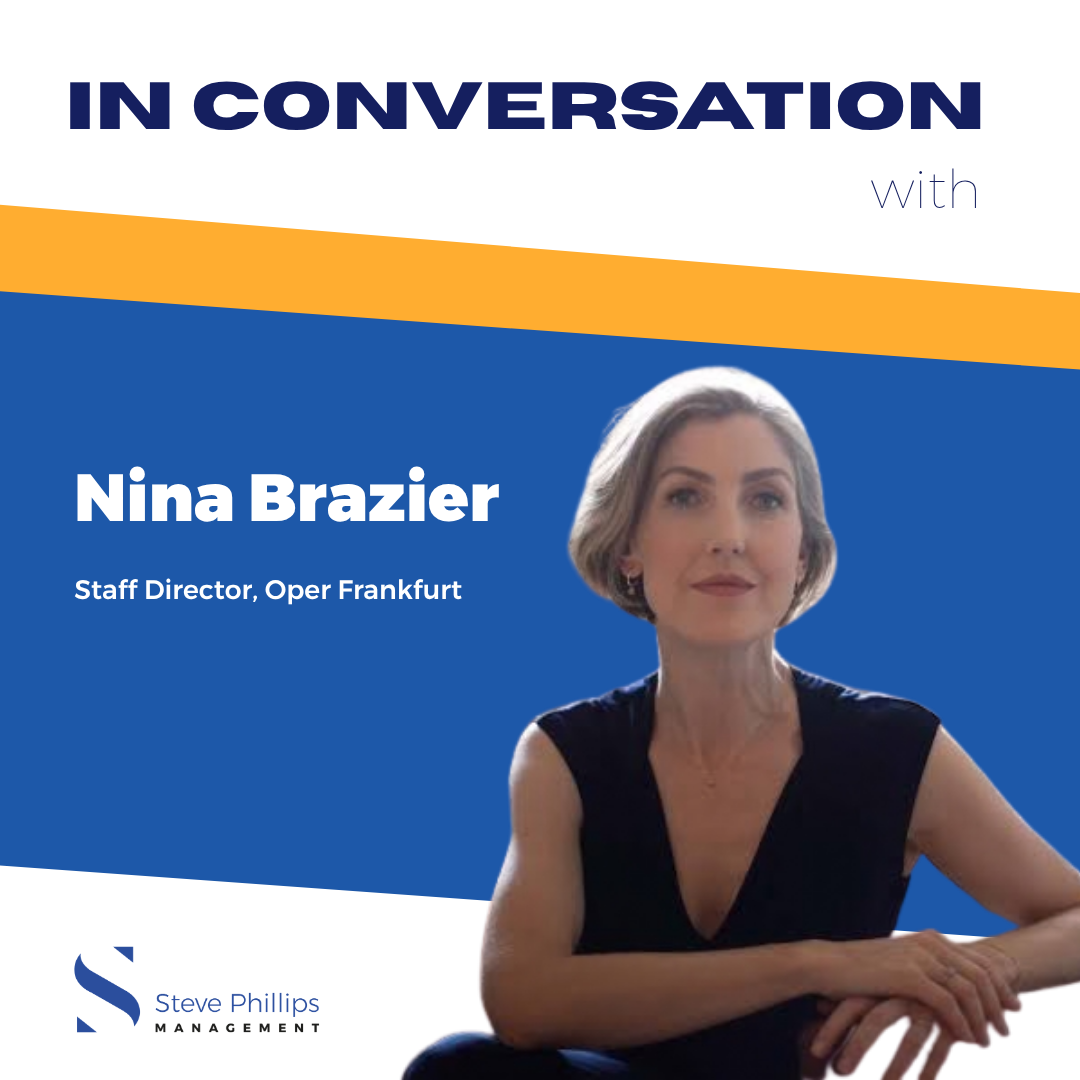
In conversation with Nina Brazier
Nina Brazier is a Staff Director at Opera Frankfurt known for her sensitive, clear-sighted direction (Opera Today) and described as a ‘skilful director’ (Opera Magazine) with ‘genuine music theatre sensibility’ (Opera Now).
Nina is also a podcast Curator and Host, previously of OperaVision’s Next Generation podcast series, following two years of her acclaimed industry podcast The Opera Pod.
How do you work with singers in your current role at Oper Frankfurt?
In my role I'm either directing a revival of a show that already exists, or I'm assisting a guest director on a new production. Those, of course, have very different timelines and schedules - generally up to six weeks for a new show, or under two weeks for a revival. We have two stages in Frankfurt, the main house which is over 1300 seats and a smaller stage, and the Bockenheimer Depot, which seats up to around 400. I've had the opportunity to direct a show at the Depot, a whole host of revivals and some children's operas too, so I can be moving around quite a lot over a season.
As a staff director, my work with ensemble members and young artists can involve directing and supporting them into a revival, or preparing them for cast change rehearsals in the middle of a run, or a last minute jump-in, or jumping into a role on stage myself, which has also happened many times! On a new production (where there are two assistants) we would be assisting the director, organising the schedule, passing on notes to the cast, alongside being in constant communication with the company office and different other departments of the theatre.
Tell us more about the children’s operas. Are they standard operas like Magic Flute and Hansel and Gretel, or are they specially commissioned works for family audiences?
Well, we've got a bit of both. There are certainly some things on the main stage that would suit family audiences, such as a Hänsel und Gretel, Die Zauberflöte or Die Banditen, but we also have an Oper für Kinder strand. Their pieces are catered to young audiences, and sometimes the shows are different versions of what is on on the mainstage with dialogue inserted to support the story, or sometimes a more recent composition, like the recent Hölle directed by my colleague and friend Silvia Gatto. I haven’t yet known a piece to be especially commissioned by us. I’m currently directing a Turandot for children, with an adapted text (and a different ending!). Designed by set designer Christoph Fischer who is in house, with Polina Shpazhnikova from the costume department who has drawn together a costume design. There is a very small budget for set, and literally no budget for costumes, so we have to source from what is in storage - so it does come with some compromises.
Is that kind of work always in the second space, or do you use a foyer, school or something site specific?
At the moment we have a really interesting third space that I didn’t mention before — the Neue Kaiser. Since 2023, we’ve been using it for the children’s operas and for other events. It’s a neo-Baroque former bank building that we’ve taken over in a pop-up way, although only until the end of this season. Before that, the children’s operas were performed in the foyer of our main house, which is a bit cosier. In both settings it’s just a joy to see the amazement of the children as they experience live opera, either for the very first time or as a seasoned young visitor.
Is that sort of work a growth area for singers alongside the main stage?
It absolutely can be. In the children's operas we would often get a combination of young artists, ensemble members, and guest singers too. A freelancer might be recently out of the Hochschule (the conservatoire here in Frankfurt), or someone who is playing or has played a smaller role on the mainstage or the Depot, or perhaps someone who has recently auditioned. In the upcoming Turandot, for instance, I have two young artists from our opera studio, one Ensemble member, one freelance singer, and a teenager from the children’s chorus. It can also be a big challenge in terms of getting into the German dialogue, for everyone who is not a native speaker - including me!
You work in an international House, is there anything that surprised you when you started working in the German system?
The initial thing is the rehearsal times, which are often 10-1pm and 6-9pm, and later on 7-10pm when you’re on stage. That takes a bit of getting used to, and I find it can be especially tricky for juggling family life.
The next thing that struck me is that there's no stage management running the room. I'd already observed a show in Germany, and assisted as a second assistant before I took on the job of a staff director, so I knew what was coming. There’s nobody saying, ‘Stand by for your entrance, don't forget your cigarette/money’ or whatever it is…and there's nobody giving that entrance cue - that all comes down to the staff/assistant directors.
The best way to explain it is perhaps to compare my final freelance job before leaving the UK with my first revival at Oper Frankfurt. I’d been assisting on Ariadne auf Naxos, a revival at the Royal Opera House directed by Julia Burbach, where we had a great team: one revival director, two assistants, and one observer. There were then two ASMs and a DSM at least. So four people on the directing team, and at least three stage management - seven people in the rehearsal room. My first job in Frankfurt was to revive Ariadne auf Naxos, (a different production) on the main stage, and it was just me. I had no assistant, I had no stage manager…so where there had been seven people in a stage of a similar size, there was just one person, and that was me. Sometimes, it still takes me a minute now, after nearly 10 years, to think that singer should be coming in, oh no, that's my job…I should give them a standby, give them a cue, even if that’s from the front of the room where you’re busy writing your notes.
Also, in a revival, the rehearsal costumes may be wheeled into the corner of the rehearsal room, but if I need more knee pads, or another pair of socks, or the soles are too slippery I’ll need to go and ask someone for that myself. If the set needs to be changed, I call the technical staff - there's no one in a revival doing that for you. In contrast, if you’re working on a new production, it does look more similar to the UK. So you'd have two assistants plus the director, and you'd have a design assistant, who covers some of the stage management duties, but the people still seem a lot thinner on the ground!
Having said that, I find that singers do get used to the changes really quickly. I may give them cues when we're first getting into it, but later they would take more responsibility for their own entrances. I might give them a nod to remind them, but there's a sense of the singers having to be more independent.
Knowing about that autonomy before you move to Germany, sets you up in the right frame of mind doesn't it? Rather than panicking that you're not being told everything.
Yes, and actually when you're on stage it shifts, because then there’s a DSM equivalent, and you would get your entrance cue with a light. So there's a red light that would be your standby, and when it goes out, that's your cue to enter. But you also need to know when yours is, and who is before or after you, because you don't want to walk in on someone else's entrance if there's somebody going two systems (or a few bars) before you!
Have you noticed any common issues that you wish people knew before starting to work in the German system?
I think for us in Frankfurt - I can't really speak for other houses - there can be a heavy workload for some Ensemble singers and young artists - you might be in two parallel productions, going between different rehearsal rooms and/or the stage on the same day. Here we expect a lot of our young artists, so they're not only singing in the children's opera and small roles, but they might be singing a Figaro, Pamina, Tamino, Tatyana, for instance. They might be in a second cast, where they’d get just a couple of days to rehearse, and then shown around the stage just once (and almost certainly no rehearsal with the orchestra). From what I understand, things that singers can find challenging is shifting between different repertoire, different types of role, different sizes of role…and trying to stay on top of it all. Our young artists can be in multiple productions, and preparing for the next one, but they’re also doing a masterclass, or outreach projects, or perhaps a concert that's filmed, or a recital, so there can be a lot going on. They’ll also have German classes, coachings, and visiting experts. There’s a sense you don't want to miss out on all the opportunities that are being offered, but obviously bodies have a limit, and we need to recognise that. I have had many, many conversations with our young artists for the OperaVision podcast, and juggling time and energy was a common theme.
One thing I've come across as well, is the idea that when you're in rehearsals for one thing, you’ll have time in between to prepare for the next thing, or maybe you can prepare Acts 1 and 2, and learn Act 3 as you go along. The reality is, from what I’ve seen, that doesn't really work. Of course it could theoretically work if we were able to work chronologically through a rehearsal period, but often (to do with other people's availability), you might have to rehearse the opera out of order. Perhaps someone is sick, so we need to suddenly jump to Act 3. So although it sounds really basic, prepare in advance as much as possible. One of the young artists I was talking to - Jarrett Porter, now in the Ensemble - said that one thing that had really helped him through a busy time of two shows simultaneously, was just before each rehearsal, going back over the score, looking at key moments, his entrances and exits etc. I know that sounds like common sense, but often we're rushing from one thing to the next, thinking where on earth am I?! Particularly if dealing with family or another drama going on, often you just fly into rehearsal and throw your costume on. So I think the idea of taking a moment to think, what scene are we doing? Where am I? Who am I? What am I saying? That little refresh for singers can be really helpful.
Yes, while churning through so much, you need to find what works for you, whatever else is going on. Perfection is not the answer, but developing your own habitual process can be a helpful way to navigate that.
Absolutely, and I sense the pressure on the young artists, particularly when they're doing their early debuts, or they've been promised a role and really want to make a good impression. Of course there's the pressure to perform your absolute best, but I think we need to realise the diversity of what we do here, and acknowledge that every performance is not going to be the best performance of your life, do you know what I mean? You have to understand the reality of being on a Fest contract, that you have those moments of high pressure, and huge reward, and also those moments where it's incredibly hard and gruelling, and you just have to find a way to turn up and do the job to the very best of your ability - and not forget that your best is good enough.
Do you find that often singers go from a young artist to an ensemble position in the same house, or is it usual that they may move houses. How does that work?
We do sometimes take on young artists into the ensemble each year. We've also had scenarios where they’ve not been taken on, but have come back as a freelancer, regular or otherwise, or - unusually - have come back later into the ensemble. We’ve had other scenarios where you think ‘this is an incredible singer ... .of course they'll be invited onto Fest’, but they're not, for whatever reason. You never really know where the choice lies. So I think it varies and it seems to be, with us, that we mostly maintain good relationships, and people are often asked back on a freelance basis, even if they're not brought into the Ensemble. It can often be to do with who we already have in the group, how many of each voice type there are, which kinds of roles are already covered, what's coming up in the next season and so on.
I think a young artists programme can also be a foot in the door to working in Germany for some people. I have a friend who was a young artist at an A house recently, and that went very well. She's now not on Fest there, but she went on to stay in Germany, to revisit the house as a guest, and used the experience as the stepping stone to getting other auditions and other work.
Is it usual for people to stay in a Fest contract for many years, a decade or so, or is a couple years, then move on a better approach?
I think it varies, and can go any direction. Some singers come on a promise and are lucky enough to get a series of roles that they feel are right for them. However, some seasons later, they may not get the roles that they’re hoping for or expecting, which instead go to the next ‘up-and-coming’ singer… My advice would be to take the opportunities that you can, learn and flourish as much as you can while you're there, and see how it pans out. As we know we are in this culture at the moment where everyone wants the 'next young/rising star’, so if you have seasons where you're not getting the roles you feel you should be, then perhaps you need to have a conversation with the management about where the house sees you going in the future. I've seen people say in a nice way, look, if I don't get my this, and if I don't get my that, I think there's no reason for me to stay here as I could earn more as a freelancer, which is a fair argument, especially if there other houses offering them those roles. I think there can be a turning point for singers, where if the offers they are getting feel too good to refuse, that is an answer in itself. It’s also of course a very personal question: would you like to travel more, work in different houses, sing different repertoire? Or are you prepared to compromise on the roles you would prefer to have for family/caring responsibilities, schools, and so on. We also have a rule whereby if a singer is employed for fifteen complete seasons (or years) they become ‘unkündbar’, unfireable until they retire.
So from what could be perceived as a rigid system, there’s actually a lot of flexibility within it?
In some ways, and it can work both ways. You can say, look, I really want to stay, but I really would like to have this role, because that should be in my repertoire, and now's the time I need/would like to be singing it. Although I don't think that ultimatums are the way to go! However, you can say it's really important to you, even if you come in on the second cast. If they still see you doing something very different to how you see yourself, or you feel yourself sidelined, then maybe it's time to think about your options. I've seen people have those conversations, leave, and come back happily as a freelancer. So I think it's about being honest about where you see yourself and the house sees you, and if you can align your interests.
Do people tend to live very close to the house, or do they live far out? That's obviously a consideration with long days or split days, isn't it?
Lots of people are pretty close. Frankfurt is almost a tenth of the size of London, so it feels much more manageable to me. Sometimes, couples or friends with families move a bit further out to have more space. I live really close to the theatre, five minutes on the bike, which I find massively convenient with the split days - especially after finishing a rehearsal at 10pm, but I would say mostly people live no more than half an hour away.
What has struck you most with your Podcast conversations over the years?
Pick up the ‘phone Some singers looking to move had basically got on the phone from the UK, calling houses and agents to ask for auditions or to be heard for a working session, and then organised an audition tour. I found some freelance singers got a foot in the door this way, whether it was finding a concert agent, a fest audition (and later contract) or just some career advice and audition experience. There seemed to be no downside to saying; ‘OK, I'm coming over to visit and meet agents, do you want to hear me?’ rather than hiding behind an email. Even better if you try it in German.
Start at the beginning Another friend came and joined an Ensemble in a very small house, because she wanted to get some repertoire under her belt, and that was with a view to saying, okay, I'm going to join this ensemble for two years, and because it's a small house with a small Ensemble, I'm going to take on these roles that I want to be singing, and then I'm going to move on’…and that's exactly what she did. I don't want to say step below your level, but she took what was offered with a view to building on that. Often we think, I need to have a this level role in this level house, A, B, whatever it is. Whereas actually you can look to have an ‘entry level’ job and build from that.
Listen to your own voice On the young artist's side, what really resonated, after hundreds of conversations, was the idea of truly listening to your own voice first and foremost. It seemed that with all the experts and coaches both from in and outside the house, that there are so many suggestions coming from different sides that it can feel overwhelming. So the idea of having a strong built-in filter about what specifically works for you, and to be prepared, politely, to take what's useful and reject what's not.
No does not mean never This one harks back to The Opera Pod years. Early on in her career, Angel Blue did an audition tour of 10 opera houses all across Europe, and not one house wanted to hire her, and she felt so utterly and deeply rejected. Years later, those same houses were coming back to her and offering her contracts.
Your best is good enough (copyright Nombulelo Yende!): remember that your best is good enough. We spoke earlier about how prevalent perfectionism is, and how we always want to show up as the best possible version of ourselves. But I think it’s important to remind ourselves that our worth isn’t determined by how the performance went last night. Your value as a person doesn’t just depend on how you sing - that’s something really important to keep hold of.
That’s so true, do you have any final advice for someone thinking of moving to Germany to work as a singer?
Enrol in a German language course as soon as you can, and work through learning the language as far as you can. At the Goethe Institute the courses were surprisingly cheaper in London than they were in Germany. If you can get to B1, that would be a useful working level to start with. There's also the Conversation Exchange (https://www.conversationexchange.com/) website, which is quite clunky, but you can sign up and find a German speaker who wants to learn English - I found it hugely useful both before and after moving.
I think being prepared to be brave and just try out the language, even when you come to audition. People don't need your German to be perfect, but they do want to see that you're going to make the effort. So if you can structure some sentences, even if you can't always answer what comes back to you, you're showing willingness, not just having a kind of closed-door ‘I’ll present you my package’. It shows you're a work in progress, and that you're building towards working proficiency in the language - you can always switch to English if you get lost.
The other thing that might throw you is that revival rehearsal periods can be so short, sometimes even within eight days (and even shorter at some other houses). So I think once you are coming here, or joining an Ensemble, you should be prepared to be more self-sufficient. Study the video in detail. Note down and learn what you do on stage so you can be genuinely prepared when you start rehearsals. The more prep you can do, the more you can be free to really make the role your own, instead of just tracking the journey of the person who did the production originally.
I guess that's where the magic happens, and how you get noticed and fly on stage?
Exactly - I was really lucky with some of my revivals. I had one cast in particular who were so well-prepared so we could have fun with it, and make it our own in the way that you know the original director would have done, without compromising the vision of the original show.
Nina will be joining Grasmere Song in 2026 as part of The Professional Path: The Professional Path | Grasmere Song @ Ambleside